
Once BioShock Infinite’s protagonist Booker DeWitt arrives in the floating city of Columbia, local law enforcement begins gathering descriptions of the False Prophet they’ve been anticipating for years. The catch? They’ve spent ages whipping up public hysteria fueled by xenophobia. Consequently, when interviewing eyewitnesses, all they receive is bigoted terror.
Radio reports claim Booker is either a mixed-race dwarf or a Frenchman missing his left eye—standing no taller than four feet nine inches. When DeWitt overhears an artist assembling a facial composite sketch, the conversation proves utterly farcical.
“He was taller… slimmer. His eyes were further apart. Bigger than that. Squinty. His hair was… hmm, red and curly? He looked Irish to me. Yes, like that. Oh, he was certainly an anarchist. You can spot them anywhere, you know.”
It’s a silly detail, yet one of BioShock Infinite’s most subtle touches—a way for developer Irrational Games to illustrate how a backward society collapses under its own narrow-minded beliefs. This scene resurfaced during this summer’s Xbox Showcase, where Clockwork Revolution finally received an extensive reveal.
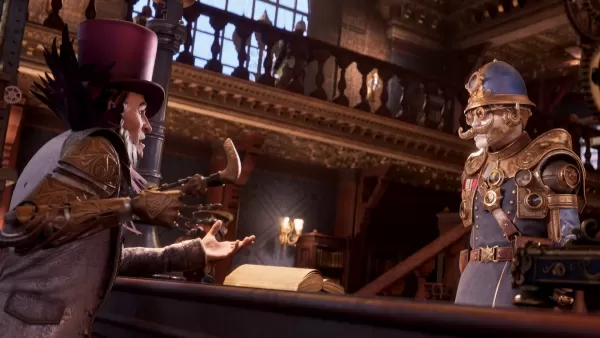
 Clockwork Revolution's steampunk world is rife with absurd role-playing opportunity. | Image credit: InXileBioShock Infinite served as the immediate and obvious reference for a first-person action game set in turn-of-the-century Victoriana featuring time-twisting mechanics. While we’ll be “playing in the mud” rather than soaring through the skies, InXile’s new title depicts a society where power imbalances have created a volatile atmosphere. Here, shootouts on factory floors involve vintage rifles and temporal magic. With a flick of your wrist, you can revert rubble back into a wall to take cover behind it. It aligns perfectly with our memories of Irrational’s swansong.
An early scene features an aristocrat buzzing with outrage in a police station lobby, offering an eyewitness description of a burglary suspect. “Tall… built rather slim,” the lord mutters to a mechanical constable. “Well, muscular. Was very quick, agile. With a moustache. No, larger!”
This time, however, the takeaway differs significantly. InXile isn’t highlighting bigotry here, but rather the flexibility of its character creation tools. At its core, Clockwork Revolution is not a first-person shooter, but a western RPG in the tradition of Wasteland, The Bard’s Tale, and Planescape: Torment—all franchises for which the studio has previously delivered successors.
At the start of your campaign, you can define your background as a Gearsmith who scavenged through life or a Bookwarden rescued from an orphanage by a wealthy sociologist. You’ll select traits with names like Street Stalker and Steam Whisperer, distributing attribute points to determine resistance to chemicals or conversational flair. Your journeys back in time will send ripples into the future, altering the city around you—a tantalizing prospect for fans of reactive RPGs.
The over-the-top tone actually reinforces the RPG systems. It creates space for character decisions that don’t simply adhere to genre conventions.
In fact, despite initial impressions, Clockwork Revolution shares more in common with The Outer Worlds 2 than Ken Levine’s opus. Obsidian’s upcoming sequel, also featured in this year’s Xbox Games Showcase, similarly emphasizes reactive worldbuilding and the unique quirks that define a truly distinct player character. As game director Brandon Adler explained during The Outer Worlds 2’s Direct presentation, you play as an Earth Directorate agent—essentially a sky marshal. However, the game doesn’t lock your background or personality. You might have joined to escape outstanding warrants for crimes committed, or be a fraud riding a deadly reputation earned from an accidental kill. You can’t be a Gearsmith, but you can be a Roustabout who fails upwards.
Both games share a Wizard-of-Oz aesthetic in their art direction, featuring slightly garish palettes and ornate armor designs that look like they were styled by Jon M. Chu. They don’t demand serious attention—especially when, in Clockwork Revolution, a mechanical doll screams to “keep your filthy pickers off me.” In both cases, this exaggerated tone supports granular RPG systems. It allows for character choices that go beyond genre clichés.
For a tangible example, consider Flaws in The Outer Worlds 2. Taking Bad Knees lets you move faster but causes your joints to pop when standing from a crouch, revealing your position to enemies. If you’re a Kleptomaniac, your character might snatch an item while browsing without warning, forcing you to explain yourself to guards. Is the trade-off worth the better selling prices? Only you can decide.
 Far from a grounded RPG party, The Outer Worlds 2's rag-tag crew will permit all sorts of oddball approaches. | Image credit: Obsidian EntertainmentIn an unconventional power fantasy, you can choose to be Dumb in Obsidian’s RPG—allowing you not only to embarrass yourself in conversation but also to fix a computer by shoving a tin of hot dogs into the fuse box. This scope for wilfully idiotic decisions is reflected in Clockwork Revolution as well—as seen when the protagonist repeatedly ignores an intimidating shopkeeper named Uncle Alfie to speak with his underling, Errol. After a couple of unwise dialogue choices, poor Errol ends up splattered across the floor, his head crushed by a candlestick wielded by his agitated employer. “Brains,” chuckles Alfie. “If I hadn’t seen it with my own eyes, I wouldn’t have believed it.”
Scenarios like these offer laugh-out-loud surprises—rare in an RPG genre where character and conversation choices often feel familiar. More importantly, they wouldn’t fit into the more serious universes of Obsidian’s Avowed or InXile’s Torment: Tides of Numenera. Essentially, the absurdity of these settings keeps the genre varied and fresh—and may even push it forward.
AnswerSee ResultsOf course, zaniness is an acquired taste, and there’s a risk these games might overstep into tonal territory that becomes grating rather than gratifying. But choice-driven RPGs allow their most extreme elements to remain optional. Nobody forces you to wield the Spectrum Dance sabre in The Outer Worlds 2—a musical sword that grants damage bonuses if you strike enemies on the beat. It’s your choice, and you can tune the tone of your experience to suit your preferences.For now, I’m eager to build my own composite sketch of a cockney criminal in Clockwork Revolution—with the help of a robot constable who grows suspicious as I pump points into Social skills. “Why do you think they’re so charismatic?” he asks warily. “Are you sure this wasn’t a jilted lover?”



![A Father’s Sins – Going to Hell [Ch. 7 Public] By Pixieblink](https://images.hzyry.com/uploads/67/1719578270667eae9eb6a75.jpg)